
English| EUR
Suggested for you
More currencies
Choose a language
Mooloolaba hosts multiple whale watching operators during the annual humpback migration, each with distinct vessel types, route patterns, and service standards. Visitor reviews reveal consistent patterns in sighting success, crew knowledge, and onboard comfort that can guide your booking decision. This page synthesizes verified feedback to help you select an operator aligned with your priorities.
Quick answer
Mooloolaba whale watching reviews consistently highlight sighting success rates above 95% during peak migration months (June through October), with Sunreef operating from The Wharf Mooloolaba receiving frequent praise for marine biologist commentary and stable catamaran platforms. Visitors report that morning departures between 8:00 and 11:00 deliver calmer sea conditions and more active whale behavior, while afternoon tours occasionally face choppier water and reduced visibility.
The Sunshine Coast's whale watching season draws humpback whales along a migratory corridor that passes within five nautical miles of Mooloolaba's coastline, creating predictable encounter zones that operators have mapped over two decades of daily departures. This proximity means most tours reach sighting areas within 20 minutes of leaving The Wharf, a factor that guests with seasickness concerns mention frequently in reviews. Mooloolaba whale watching reviews reveal a clear preference for operators providing marine biologist or naturalist-led commentary rather than scripted announcements. Guests consistently rate educational depth as a deciding factor when recommering tours to others, with detailed explanations of breach behavior, calf-rearing patterns, and migration timing earning higher satisfaction scores than tours focused solely on photography opportunities. Vessel stability emerges as the second most-mentioned review criterion, particularly among families with young children and older visitors. Catamaran designs receive favorable mentions for reduced roll in moderate swells, while smaller monohull vessels draw mixed feedback depending on sea state during the specific departure. Feedback patterns show that sighting guarantees—offered by most Mooloolaba operators—significantly reduce booking anxiety but rarely require activation during the June-to-October window. Reviews from shoulder season departures (late May and early November) note lower whale densities and advise flexibility in travel dates. The Wharf Mooloolaba's central location allows visitors to combine whale watching with the Esplanade precinct, a convenience factor that repeat guests cite when comparing Mooloolaba to operators in nearby Caloundra or Noosa. Recent visitor reviews emphasize the value of asking operators about their spotter network and whether they coordinate with other vessels via radio to share real-time sighting locations. Tours employing this cooperative approach receive higher ratings for encounter variety, as vessels can reposition toward breaching pods or slow-traveling mothers with calves. Guests booking through The Wharf departure point at 123 Parkyn Parade note streamlined boarding processes and accessible facilities, factors that matter for visitors with mobility considerations or tight schedules.
“The proximity of the migratory corridor means most tours reach encounter zones within 20 minutes, a factor guests with seasickness concerns mention consistently.”
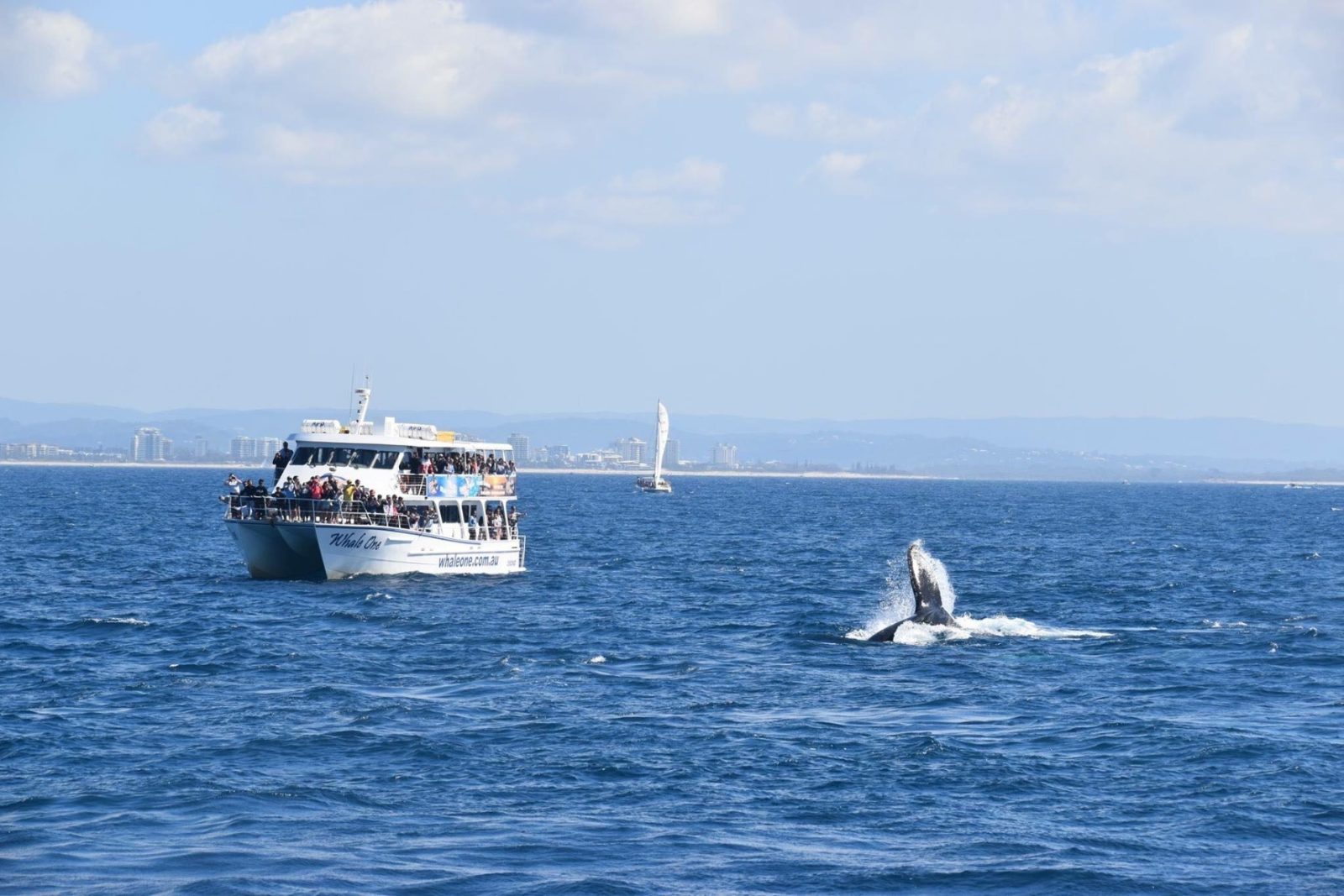
Deciding on a Mooloolaba whale watching tour comes down to choosing between Whale One, a large and stable catamaran, and Adventure Rafting, a fast-paced rigid inflatable boat. Each style offers a completely different passenger experience on the water during the annual humpback migration.
| Whale One (Sunreef) Large Double-Deck Catamaran Recommended | Adventure Rafting High-Speed RIB | |
|---|---|---|
| Boat type & size | 19.5-meter multi-level catamaran with an enclosed saloon | 12-meter custom-built rigid inflatable boat (RIB) with open seating |
| Capacity & crowd size | Up to 110 passengers per sailing across multiple decks | Maximum of 20 passengers per tour for unobstructed views |
| Wetness & splash level | 0% chance of spray in the cabin; stable sailing | 100% open-air exposure; spray jackets and goggles provided |
| Unique features | 2 onboard licensed bars, toilets, and 360-degree decks | 500-horsepower twin engines and an underwater hydrophone |
| Ticket guarantee policy | 100% sighting guarantee offering a free return voucher | 0% sighting guarantee; no partial refunds or repeat trips |
Verdict: Families and those seeking comfort or a sighting guarantee should book Whale One, while adventure seekers wanting a fast, small-group trip at water level will prefer Adventure Rafting.
Reviews consistently show that the peak window for whale watching in Mooloolaba runs from July to October, with early morning departures offering the most favorable conditions. Tours departing between 08:00 and 11:00 benefit from calmer morning seas and higher rates of active humpback sightings.
Mild winter, highs of 21°C–22°C
These winter months mark the peak northward migration. Morning conditions are often crisp and clear, though wind jackets are recommended for the open deck.
Warm spring days, highs 21°C–27°C
This is the crossover period where mothers and new calves return south. Water clarity improves and warmer daytime temperatures make for comfortable deck viewing.
—
The 08:00 to 11:00 departure window offers the calmest seas before afternoon winds develop. Reviewers note this timing reduces sea sickness risk and aligns with active whale behaviors.
Verdict: A Tuesday to Thursday morning between 08:00 and 11:00 during August or September.
Reviews from past passengers reveal several recurring regrets that are easily avoided with advance preparation. The most common errors involve physical comfort, booking terms, and departure logistics.
Boarding without seasickness medication
Many passengers report nausea on rougher days. Take medication 30–60 minutes before departure, even if you rarely experience motion sickness—ocean swells differ from car or plane travel.
Choosing a large catamaran when mobility is limited
Reviewers with knee or back issues regret multi-level vessels with steep stairs. Book a smaller, single-deck boat or confirm accessible seating when you reserve.
Skipping the whale guarantee clause in your booking
Not all operators offer a free return trip if no whales appear. Verify the guarantee policy before paying—Sunreef provides one, but terms vary across providers.
Arriving at the wharf without confirming your departure berth
The Wharf Mooloolaba houses multiple operators at different berths.
Booking peak season tours without reading cancellation terms
Winter weekends fill quickly, and last-minute changes can forfeit your payment. Review the cancellation window when you book—most operators require 24–48 hours' notice for a refund.
Prepare for your Sunshine Coast cruise with these reviewer-backed strategies to secure the best views and ensure a smooth experience on the water.
To claim a forward vantage point on Whale One, board early and stand near the railing. Ensure you are steady on your feet, as this area experiences the most movement when the vessel encounters swells.
Avoid relying solely on phone zoom lenses by opting for the professional photo package.
Book a Tuesday or Wednesday departure to avoid the high passenger volumes of weekend cruises. Fewer people on deck means more room to move and clearer sightlines when whales emerge.
Take motion sickness medication at least 30 minutes before boarding the vessel. The waters beyond the Mooloolaba River mouth often experience significant swell, even on days that look calm from the shore.
Complete your waiver online prior to arrival to expedite the check-in process at The Wharf. You must still collect a physical boarding pass from the office before entering the boarding queue.
If participating in a swim experience, slide into the water with minimal splashing. Sudden movements or loud entry can startle the humpbacks, causing them to swim away from the group.
Keep a close eye on your text messages and email the afternoon before your trip. The crew sends final confirmation updates around 16:00 based on the latest offshore swell and wind forecasts.
A short list of items and tasks that will help your morning on the water run smoothly.
Everything you need to know about whale watching mooloolaba reviews
Yes, many whale watching mooloolaba reviews advise visitors to prepare for open ocean swells. Several reviewers who experienced sea sickness suggest taking preventative medication prior to boarding the vessel. Choosing a larger vessel or booking during the calmer morning hours can also help minimize discomfort.
Analysis of various whale watching mooloolaba reviews shows that the standard two-hour tour duration is highly rated. Travelers note that this provides ample time to locate the pods without spending too long on the water. Families with younger children especially appreciate this shorter timeframe as it keeps the kids engaged.
Certain tours offer the unique opportunity to swim with whales Mooloolaba on a natural basis. Reviews mention that this activity is highly dependent on safe ocean conditions and the cooperation of the marine mammal. If the pod is receptive, participants can slide into the water with a guide to observe them up close.
Policies vary depending on the operator you choose for your Sunshine Coast whale watching experience. Some companies offer a return voucher if no whales are spotted. For land-based viewing, reviews often recommend Point Cartwright as an excellent coastal lookout.
Mooloolaba Whale Watching Tours & Boats
Read more GuideWhale Watching Departures from Mooloolaba Wharf
Read more GuideThe Mooloolaba Whale Watching Experience
Read more GuideMooloolaba Whale Watching Season & Best Time
Read more Tickets & toursMooloolaba Whale Watching Tickets & Prices
Read more